Diaspora Investor Tips
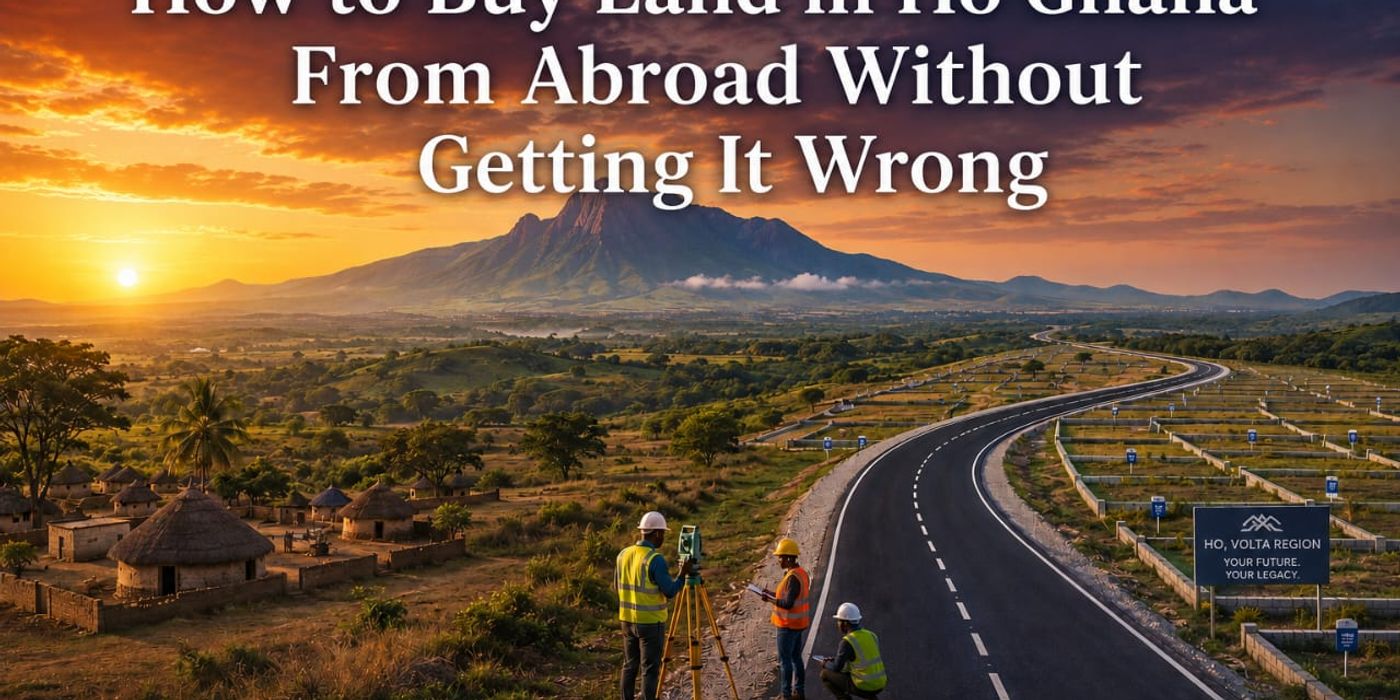
How to Buy Land in Ho Ghana From Abroad Without Getting It Wrong
Richard Adaze
19 May 2026
Buying land in Ho, Ghana from abroad is entirely possible. I work with diaspora buyers regularly, managing the full verification and documentation process on their behalf while they remain in the UK, the US, Europe, or Canada. It can be done safely and correctly. But it carries specific risks that domestic buyers do not face in the same way, and understanding those risks before you start is what separates a successful purchase from an expensive mistake.
Here is what you need to know.
Why diaspora buyers are more vulnerable than they realise
When you are buying from abroad, you are dependent on what people tell you and show you. That dependence creates a gap that not every seller or agent manages honestly. The Volta Region land market is not full of fraudsters. But it is full of people who will tell you what you want to hear, move you faster than the process allows, and count on the fact that you cannot verify anything independently from where you are sitting.
The three traps diaspora buyers fall into most often are the information gap, the urgency trap, and misplaced trust in well-meaning contacts.
What is the information gap and how do you close it?
The information gap is the difference between what you are told about a piece of land and what is actually true about it. From abroad, you cannot walk the land, speak to the neighbours, visit the Lands Commission, or sit with the family elders. Everything you know comes filtered through whoever is managing the transaction on the ground.
The only reliable way to close that gap is to work with an independent consultant whose mandate is specifically to represent your interests, not to close the sale. Not a family member who means well. Not the seller's agent. Someone whose job is to verify everything, document what they find, and report back to you clearly and in writing at every stage.
What is the urgency trap and why is it so effective on diaspora buyers?
The urgency trap is when a seller or agent tells you the land will be gone in days, the price is about to increase, or another buyer is about to close on the same plot. This is designed to push you into a decision before you have completed the verification process that protects you.
It works particularly well on diaspora buyers because you are already managing time zone differences, limited availability, and the emotional pull of wanting to secure something before you have to fly back. Urgency is your enemy. No legitimate opportunity disappears because a buyer insisted on completing due diligence properly. If anyone is creating artificial pressure around your timeline, slow down, not speed up.
Can you trust a family member to manage the transaction?
This is the question I am asked most often by diaspora buyers, and I want to answer it honestly. A family member who means well is not the same as someone who knows the process. In my own early career, the transaction that nearly ended everything for me involved someone who genuinely wanted the best for me and my client. His intentions were good. His knowledge had gaps. Those gaps cost us both dearly.
The informal verification steps in a Volta Region land transaction require specific knowledge: which families hold which corridors in Ho, how to approach elders correctly, how to read a Lands Commission search result, and what questions to ask neighbours that will actually reveal a problem. A well-meaning family member without that specific knowledge cannot protect you the way an experienced consultant can.
What does a safe diaspora purchase actually look like?
A safe diaspora purchase follows the same seven steps every buyer must follow, with two additions. First, every step is documented in writing and reported to you before proceeding to the next. You should never be in a position where you do not know exactly where your transaction stands. Second, every payment is made by traceable bank transfer with a clear reference, and every payment has a receipt. Cash payments and informal mobile money transfers without documentation leave you with no paper trail if something goes wrong.
You can read about the full documentation process in Site Plan vs Indenture: What Every Buyer Needs to Understand.
What should you do before you commit to anything?
Before you agree to anything, send a deposit, or make any commitment to a seller, do three things. First, confirm the current market price for land in the corridor you are looking at so you know whether what you are being quoted is reasonable. Second, confirm that whoever is managing the process on the ground has no financial relationship with the seller. Third, confirm that the full seven-step verification process will be completed before final payment is released.
The Volta Region is at a genuinely exciting moment. Infrastructure is arriving, institutions are growing, and land that is modestly priced today will tell a very different story five years from now. You do not have to be in Ho to be part of that story. You just have to be informed, patient, and properly supported.
If you are ready to start and want someone to manage the process correctly on your behalf, book a free consultation here.