
Legal and Documentation
Leasehold vs Freehold vs Customary Interest: The Land Ownership System Every Buyer in Ghana Must Understand
Richard Adaze
19 May 2026
There is a misunderstanding I encounter constantly in land transactions across Ghana, and it causes confusion for buyers long after money has changed hands.
A buyer says they have "bought land." I ask what type of interest they purchased. They pause. Nobody explained that part to them.
This matters more than most people realise.
Because in Ghana, buying land does not always mean the same thing. Two people can each say they own land while holding completely different legal interests with completely different rights, timelines, restrictions, and long-term implications.
If you do not understand the type of interest you are acquiring before you pay, you can make decisions that create serious problems later, especially when it comes to inheritance, resale, redevelopment, or registration.
So let us slow the process down and understand the system properly.
Why Land Ownership in Ghana Works Differently
In some countries, land ownership operates through a relatively simple framework. A person buys land and owns it permanently.
Ghana is not structured that way.
Land ownership in Ghana exists within a layered system shaped by customary authority, constitutional law, state regulation, and historical landholding structures that predate the modern republic itself.
That is why understanding land in Ghana requires you to ask a more precise question than simply:
"Who owns this land?"
The more important question is:
"What kind of interest is being transferred to me?"
Because the answer determines:
- how long your rights last,
- who retains underlying ownership,
- what happens when the term expires,
- whether the land can legally be transferred to you at all,
- and what protections or limitations apply to your ownership.
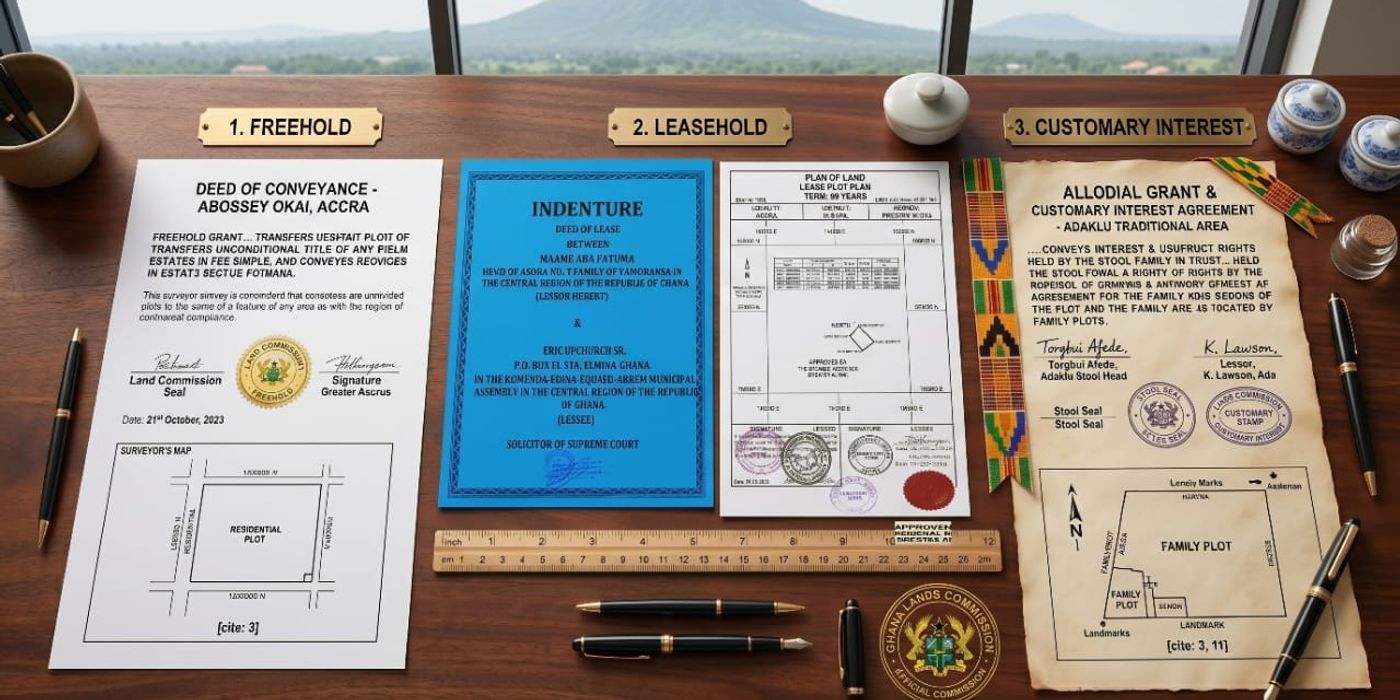
The three land interests every buyer in Ghana must understand are:
- customary interest,
- leasehold interest,
- and freehold interest.
Everything else in the market sits somewhere within those structures.
Customary Interest: The Foundation of Most Land in Ghana
Before we talk about leaseholds and freeholds, we need to understand the foundation underneath both of them.
The majority of land in Ghana is customary land.
That means the land is not originally owned by the state or by a private individual in the way many buyers imagine. It is held collectively by traditional authorities, families, stools, skins, or clans under customary law systems that have existed for generations.
In the Volta Region specifically, much of the land market operates through family land structures. That is why buyers regularly encounter family heads, elders, and collective decision-making during transactions.
This is not a technicality. It is the ownership structure itself.
When a family or stool controls land, individual family members do not automatically have unrestricted authority to sell any portion whenever they choose. The authority to transfer interests in the land ultimately traces back to the recognised custodians of that collective ownership structure.
That is why meeting the family head and elders during verification is not ceremonial. It is part of confirming whether the transaction can be legitimately defended later if challenged.
A buyer who ignores the customary ownership structure is not simplifying the process. They are removing one of the most important layers of protection available to them.
Leasehold Interest: The Most Common Urban Land Interest
The vast majority of buyers in Ghana today, especially in urban and developing areas, are purchasing leasehold interests.
A leasehold gives you the legal right to occupy, use, develop, and benefit from land for a defined period of time under agreed conditions.
Notice the distinction carefully.
You are not purchasing the underlying allodial ownership itself. You are purchasing time-bound rights over the land.
That time period matters.
For Ghanaian citizens, leasehold periods commonly range up to 99 years depending on the transaction structure and landholding authority. For non-Ghanaians, the Constitution restricts land interests to leaseholds, generally up to 50 years.
During the lease term, your rights are substantial. You can build, develop, rent, transfer, assign, or sell your remaining lease interest subject to the terms of the lease agreement and applicable law.
But the underlying ownership interest remains with the original customary authority, family, stool, clan, or state institution that granted the lease.
When the lease period expires, the interest reverts unless renewed.
This is why the remaining lease duration matters enormously when evaluating land.
A plot with ninety years remaining and a plot with twelve years remaining are not equivalent assets even if they sit side by side.
One of the most common mistakes buyers make is focusing entirely on location and price while ignoring the remaining lease term attached to the property.
Time is part of the value.
Freehold Interest: The Most Misunderstood Land Interest
Freehold is probably the most misunderstood term in Ghanaian real estate conversations.
People use the word casually to imply absolute ownership forever. The legal reality is more nuanced.
A freehold interest is the highest form of private ownership interest recognised within the legal system. It gives the holder potentially indefinite ownership rights rather than rights limited by a lease term.
But in Ghana, freehold interests are heavily restricted.
The 1992 Constitution significantly limited the creation of new freehold interests in stool and customary lands. Existing freehold interests created before those constitutional restrictions may still exist legally, but the creation of entirely new freehold grants over customary land is generally prohibited.
This is why genuine freehold transactions are far less common than many buyers assume.
And this is also why buyers must be extremely careful when sellers casually advertise land as "freehold" without properly explaining what that means legally and historically.
Do not rely on labels. Verify the actual legal interest through documentation and legal review.
There is another point that international buyers especially need to understand clearly.
Foreigners cannot hold freehold interests in Ghanaian land.
If you are not a Ghanaian citizen, the highest interest available to you legally is leasehold.
Any seller promising a foreign buyer permanent freehold ownership is either misunderstanding the law themselves or misrepresenting the transaction entirely.
Why the Type of Interest Changes the Entire Transaction
The type of interest attached to land affects almost every major decision surrounding the purchase.
It affects:
- valuation,
- financing,
- inheritance planning,
- resale attractiveness,
- development potential,
- registration strategy,
- and long-term security.
A buyer acquiring a leasehold with a short remaining duration needs a completely different strategy from a buyer acquiring a long-term leasehold or an existing freehold interest.
Similarly, customary land transactions require deeper verification around family authority structures than buyers sometimes expect.
This is why serious land buyers do not only ask:
"How much is the land?"
They also ask:
- What interest is being transferred?
- Who has authority to transfer it?
- For how long?
- Under what conditions?
- And how is that interest documented and registered?
These are not lawyer's questions. They are buyer's questions.
What You Should Check Before You Commit
Before paying for land in Ghana, ask the seller or the real estate company to explain clearly:
- the exact type of interest being transferred,
- the remaining duration if it is leasehold,
- the identity of the underlying landholding authority,
- whether the interest has been properly registered,
- and whether there are any restrictions affecting transfer or development.
Then verify those claims independently through:
- the Lands Commission,
- legal review of the indenture,
- and, where customary land is involved, direct engagement with the relevant family head and elders.
Never assume ownership structure from marketing language alone.
Words like:
- "owner,"
- "family land,"
- "registered,"
- or "freehold"
can mean very different things depending on how the underlying interest is actually structured legally.
The law does not protect assumptions. It protects properly documented interests.
Understanding the System Protects You
Many land problems in Ghana begin long before litigation, disputes, or double sales appear.
They begin at the point where a buyer pays for something they do not fully understand.
Understanding land interest structures does not make the process more complicated. It makes your decisions more accurate.
Because once you understand the difference between customary ownership, leasehold interests, and freehold interests, you stop evaluating land emotionally and start evaluating it structurally.
That shift changes everything.
If you want guidance understanding the legal structure behind a land transaction in the Volta Region before you commit your money, book a free consultation and let us talk through your specific situation properly.