
Legal and Documentation
Site Plan vs Indenture: What Every Buyer Needs to Understand
Richard Adaze
19 May 2026
There is a mistake I see buyers make more often than almost any other.
They pay for land. They receive a document. They assume the document is enough. And months or years later they discover that what they have is not the legal protection they thought it was.
Most of the time this happens not because anyone deceived them, but because nobody explained the difference between the two most important documents in any land transaction in Ghana, the site plan and the indenture, and what makes each one legally valid.
I am going to explain both clearly right now.
What a Site Plan Is and What Makes It Valid
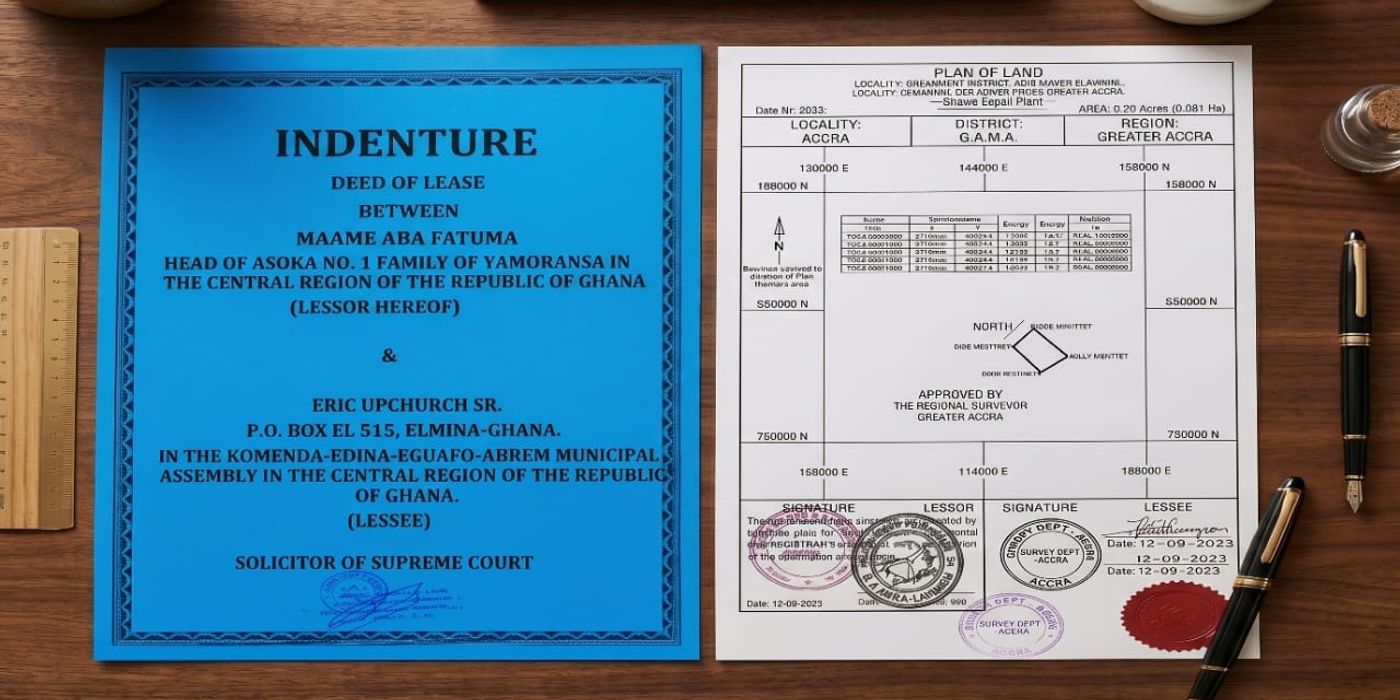
A site plan is a scaled technical drawing that captures the physical reality of your land in precise, legally recognised form. It shows the exact boundaries of the plot, its dimensions, its precise location, and its relationship to surrounding landmarks, roads, and neighbouring plots.
Think of it as the document that tells the law exactly where your land is.
For a site plan to be legally valid in Ghana it must meet three conditions. First, it must be prepared by a licensed surveyor. Not someone who describes themselves as a surveyor. A licensed one. Second, it must carry that surveyor's official stamp and signature. Third, it must be signed and endorsed by the relevant authorities at the Lands Commission.
A site plan missing any of these three elements is not legally valid regardless of how official it looks on the surface.
There is one thing about site plans I cannot stress strongly enough. Do not rely solely on the site plan the seller gives you. Get your own independent surveyor to visit the land, pick the exact coordinates of the specific plot being sold to you, and create a brand new site plan from those coordinates. I have seen sellers walk buyers around one piece of land and hand them documents that belong to a completely different plot in a completely different location. Your independent site plan is your protection against that.
What an Indenture Is and What Makes It Valid
If the site plan tells the law where your land is, the indenture tells the law that it belongs to you.
An indenture is a legal agreement between the grantor, the person giving up their interest in the land, and the grantee, which is you. It records the transfer of ownership from one party to another and is the document that converts your payment into legal ownership.
For an indenture to be legally valid in Ghana it must meet four conditions. First, it must be properly drafted, which means professionally written with the correct legal language and land description. Second, it must be signed by the grantor whose name appears in the Lands Commission system as the registered owner. Third, it must be witnessed. Fourth, and this is the one most buyers do not know to check, it must carry a court seal.
The court seal confirms that the document has gone through the proper legal process. An indenture without a court seal has not completed that process. It is not legally complete regardless of everything else being in order.
Why Both Documents Are Non-Negotiable
Some buyers ask me if they can proceed with just one of the two documents. The answer is no, and here is why.
The site plan without an indenture means you have a drawing of land with no legal record of ownership transfer. The indenture without a site plan means you have a transfer agreement with no precise legal description of what was transferred. You need both. Each one does a job the other cannot.
When you have both, properly prepared, correctly signed, and handed over at the completion of your transaction, you have what you need to demonstrate legal ownership of your land.
What to Check When You Are Handed the Documents
When a seller presents you with a site plan and indenture, examine them carefully and without being rushed.
On the site plan: check for the surveyor's official stamp and signature, the Lands Commission endorsement, and that the dimensions and boundary descriptions match what you observed on the land physically.
On the indenture: check for the court seal, the grantor's correct signature, the witness signature, and that the land description is consistent with the site plan.
If anything is missing, ask for an explanation. If the explanation is not satisfactory, do not proceed.
Documentation is not a formality. It is the difference between owning land and believing you own land.
If you want help navigating the documentation process for a land purchase in the Volta Region, book a free consultation and let us talk through your specific situation.